This passage from a long article by James Meek in the LRB about the London Underground curiously echoes some of the themes of Three Men. Or perhaps it's not so curious, as James and I were at school together in Broughty Ferry - maybe, in some subterranean manner, this gave us overlapping imaginative interests. Occasionally. Perhaps. Whichever, I trust this taster will send you to the LRB for the whole article - it's brilliantly written and researched, and highly recommended.
"One winter in the early 1990s I took an overnight train from Georgia to Yerevan, the capital of Armenia. There were no planes: Armenia was at war with its neighbour Azerbaijan, and under blockade. Snow came through the ill-fitting windows of the sleeper as it trundled between steep little peaks. When we arrived in Yerevan the next morning it was still dark: the moon had set, and the city, starved of electricity, was blacked out. Only sparse dabs of kerosene light and the occasional brace of headlights showed a city was there at all.
Robert, an Armenian PE teacher who had befriended me in the coupé, took me through the frosty murk of Yerevan’s central station and into a doorway. In an instant there was light, power, a swift transaction involving tokens, a set of escalators, and at their foot, the familiar declining whine of a clean, brightly lit underground train. We got in; the carriage was full of neatly dressed Armenians who were, in spite of everything, going somewhere – commuting. We travelled two stops, to the centre of town. I experienced the disorientating sense that the entire urban planet was connected by a single network of underground railways, functioning as a dependable back-up world rumbling away below, eternal and unchanging, whatever chaos reigned on the surface. Then we got out and climbed to the street, where there was still no power. Robert took me by the arm in the pitch darkness and led me, like a blind man, to a hotel.
Like all Soviet-era metro systems – most big cities had them – Yerevan’s is patterned on the one in Moscow, which owes much, in turn, to the London Underground. Frank Pick, one of the guiding geniuses of the glory days of the Tube between the wars, was given a medal by Stalin in 1932 (although he did not, as Wolmar romantically suggests, meet the dictator in person). When work began on the Moscow metro in 1931, it was with the possibility of
cities being attacked from the air, and of citizens finding not merely shelter underground but a whole lit-up, powered, alternative, subterranean city, invulnerable to bombs. The use of the London Underground as an air-raid shelter in the Second World War has become part of Britons’ mental slide show of the Blitz. Although few Londoners used it – 4 per cent, Wolmar reckons – some slept on Tube station platforms every night for three years, nourished by tea and buns delivered in refreshment trains, which each evening hauled tons of food around the network.
It was still earlier that London’s Underground turned from being a mere means of transport into a skeleton city-in-reserve beneath the earth’s skin. Londoners began to seek shelter in the Tube in earnest after the Zeppelin raids in 1915, and after 1917, when German bombers struck heavily, citizens poured into the 86 stations which the Underground, then privately owned, made available. At one point in 1918 some 300,000 Londoners took shelter there, when there was supposed to be room for only 250,000. During the First World War, passenger numbers on the Underground went up by two-thirds. From 1914, Tube advertising played to people’s fears. ‘It is bomb proof down below,’ one ad read. ‘Underground for safety; plenty of bright trains, business as usual.’ Another read like a sinister piece of verse:
Never mind the dark and dangerous streets
Underground
It is warm and bright
Be comfortable in well-lit trains and read the latest war news.
Two decades earlier, there had been a different attitude towards the world of the Underground. In The Time Machine (1895), H.G. Wells portrayed the beautiful, degenerate, soft-headed heirs of the aristocracy frolicking in the sunlight, prey, on dark nights, to the cannibalistic attentions of an underground-dwelling industrial proletariat. ‘There is a tendency to utilise underground space for the less ornamental purposes of civilisation; there is the Metropolitan Railway in London, for instance,’ Wells’s narrator says. ‘In the end, above ground you must have the Haves, pursuing pleasure and comfort and beauty, and below ground the Have-nots, the Workers getting continually adapted to the conditions of their labour.’"
Wednesday, 13 April 2011


Friday, 14 January 2011
PN Review us plus...
Looks like PN Review have published a review of 3 Men by N.S. Thompson here. Those of you with online subscriptions to PNR will be able to read the whole thing. Those of us with nonesuch will wait quietly on one of the great seats from Novokuznetskaya.

We (OK, I) still await (am still awaiting) detailed reports from the dva brodyagi, but Andy has divulged that, among others, they spoke to/gave copies to Manu Durand, the editor at Paulsen; Vavara Gornostaeva, the editor at Corpus, and Alexandr Livergant, the editor-in-chief at the prestigious journal Inostrannaya Literaturna (Foreign Literature). So far the latter journal has got in touch to say they’d be interested in publishing us, possibly in 2012. More on this bomb/egg/sea shell soon.
In other news, the NCLA (in association with British Council) are hosting a reading by three prominent Russian poets including the legendary Lev Rubinstein. He will be reading with Dmitry Kuzmin and Maria Stepanova in Culture Lab on the 14th of April. It is hoped that at some point we can get all three of them on the Newcastle metro.
Get your tickets here for this (surely unmissable) event.
We (OK, I) still await (am still awaiting) detailed reports from the dva brodyagi, but Andy has divulged that, among others, they spoke to/gave copies to Manu Durand, the editor at Paulsen; Vavara Gornostaeva, the editor at Corpus, and Alexandr Livergant, the editor-in-chief at the prestigious journal Inostrannaya Literaturna (Foreign Literature). So far the latter journal has got in touch to say they’d be interested in publishing us, possibly in 2012. More on this bomb/egg/sea shell soon.
In other news, the NCLA (in association with British Council) are hosting a reading by three prominent Russian poets including the legendary Lev Rubinstein. He will be reading with Dmitry Kuzmin and Maria Stepanova in Culture Lab on the 14th of April. It is hoped that at some point we can get all three of them on the Newcastle metro.
Get your tickets here for this (surely unmissable) event.
Sunday, 5 December 2010
Next gig in Middlesbrough; Dva brodyagi visit Moscow; plus squirrel news
The next outing for the gesamtkunstwerk that is our live version with audiovisual accompaniment of Three Men is January 18th at the Electric Kool Aid Cabaret of the Spoken Word held at Blu(what used to be Blaises) in Middlesbrough. More details soon.
My colleagues of the underground, Andy Croft and Paul Summers, are currently back in Moscow contacting translators and publishers for the next stage of the Myetro project: its possible appearance in Russian. Either that or they've gone to the Canary Islands and haven't tweeted me.
They've chosen to go at a time when the weather in the North East so closely resembles that of Moscow (give or take 10 degrees) that they don't have to change their outfits. (It's not clear that Andy actually can change out of that bloody jacket.)
No doubt we'll have news on this latest trip soon enough or indeed slightly later. In the meantime, the stubborn refusal of the squirrel meme to hibernate means that the stanza on the possibly-not-entirely-real station for the possibly-not entirely-there 'Squirrel Hills' demanded a successor:
Bronze panels show in Belichiy Gory
the war between the Greys and Reds --
Yeltsin's high station tells the story
that left ten million squirrels dead.
One side were Celto-Scythian rebels,
the others sleepless, alien devils:
Prince Nutkin, Tuftsky, Sasha Cheeks,
Tsar Timfy Tiptoes -- through these peaks
from birch-top fought to floor of forest,
while Greys made famine from Red's glut,
for every tree, each twig, each nut.
Why was this iconised by Boris?
While oligarchic fat cats feast,
democracy is for the beasts.
As real as Hollywood’s Ninotchka,
this station is an empty hoard
of bottles drunk by a red belochka –
stare all you want, they’ll still stay blurred.
A six foot squirrel, stark and raving
that none can see but those, half-shaven,
half-drunk, who wake in hotel rooms,
in snowdrifts, metros, Lenin’s tomb.
It tells you fables from an era
when men pissed vodka, wives shat eggs
and flies had four delicious legs.
It whispers, ‘You’re the true chimera,
a beast that thinks he knows he thinks?
No wonder wanderers turn to drink!’
My colleagues of the underground, Andy Croft and Paul Summers, are currently back in Moscow contacting translators and publishers for the next stage of the Myetro project: its possible appearance in Russian. Either that or they've gone to the Canary Islands and haven't tweeted me.
They've chosen to go at a time when the weather in the North East so closely resembles that of Moscow (give or take 10 degrees) that they don't have to change their outfits. (It's not clear that Andy actually can change out of that bloody jacket.)
No doubt we'll have news on this latest trip soon enough or indeed slightly later. In the meantime, the stubborn refusal of the squirrel meme to hibernate means that the stanza on the possibly-not-entirely-real station for the possibly-not entirely-there 'Squirrel Hills' demanded a successor:
Bronze panels show in Belichiy Gory
the war between the Greys and Reds --
Yeltsin's high station tells the story
that left ten million squirrels dead.
One side were Celto-Scythian rebels,
the others sleepless, alien devils:
Prince Nutkin, Tuftsky, Sasha Cheeks,
Tsar Timfy Tiptoes -- through these peaks
from birch-top fought to floor of forest,
while Greys made famine from Red's glut,
for every tree, each twig, each nut.
Why was this iconised by Boris?
While oligarchic fat cats feast,
democracy is for the beasts.
As real as Hollywood’s Ninotchka,
this station is an empty hoard
of bottles drunk by a red belochka –
stare all you want, they’ll still stay blurred.
A six foot squirrel, stark and raving
that none can see but those, half-shaven,
half-drunk, who wake in hotel rooms,
in snowdrifts, metros, Lenin’s tomb.
It tells you fables from an era
when men pissed vodka, wives shat eggs
and flies had four delicious legs.
It whispers, ‘You’re the true chimera,
a beast that thinks he knows he thinks?
No wonder wanderers turn to drink!’
Saturday, 18 September 2010
Bristol gig report
This was the first reading for a while to involve all three of us, and the first time we'd tried the full-on AV son et lumiere spectacular version of 3 Men ie, we included a slideshow and some MP3s, so thanks enormously to Colin Brown and Poetry Can for the opportunity.
This meant we could focus on set-list, edit some of the mass of materials the project had accumulated, and think a little about the mechanics of performing a number of quite short poems while three people stand in a line on stage. We didn't get all that all right, but it felt like a considerable step forward.
Here are the files used:
So now, if you want to recreate the reading experience in the comfort of your own treehouse, all you need is the setlist and to hit the 'play' buttons at the right moment. But I'm assuming no-one would be that bonkers.
This meant we could focus on set-list, edit some of the mass of materials the project had accumulated, and think a little about the mechanics of performing a number of quite short poems while three people stand in a line on stage. We didn't get all that all right, but it felt like a considerable step forward.
Here are the files used:
So now, if you want to recreate the reading experience in the comfort of your own treehouse, all you need is the setlist and to hit the 'play' buttons at the right moment. But I'm assuming no-one would be that bonkers.
Friday, 3 September 2010
Park Kultury
I've been meaning to write something about the terrible bombings in the Moscow Metro back in March, and have been carrying fragments of a phrase or two around with me for a while -- if the image isn't too repellent, sometimes an inspiration feels like putting together something that arrives in bits and pieces, the imagination as the opposite of a bomb. Anyway, thinking about that tragedy and its origins in another tragedy, this is the stanza that eventually came:
Kultury is twelve marble roundels
displayed along a Metro wall.
Kultury is nails bagged in bundles
explosive pressed into a ball.
Kultury’s skaters, tennis players;
Kultury’s martyrs, random slayers.
Kultury is a model plane,
a future freed from debt and shame.
Kultury is a mushroom hunter
slaughtered in the forest snow:
it's what we can't and so must know.
It is our brief reply to winter:
a warm breath’s disc in a window’s frost;
ice-hole to rivers of the lost.
Kultury is twelve marble roundels
displayed along a Metro wall.
Kultury is nails bagged in bundles
explosive pressed into a ball.
Kultury’s skaters, tennis players;
Kultury’s martyrs, random slayers.
Kultury is a model plane,
a future freed from debt and shame.
Kultury is a mushroom hunter
slaughtered in the forest snow:
it's what we can't and so must know.
It is our brief reply to winter:
a warm breath’s disc in a window’s frost;
ice-hole to rivers of the lost.
Tuesday, 31 August 2010
Three Men in a Poetry Can
Our next gig is a three person show at the Bristol Poetry Festival. Their poster seems to have been very kindly designed with us in mind:

We are on as follows:
THURSDAY 16 SEPTEMBER, 8.00PM
ARNOLFINI, 16 Narrow Quay, Bristol, BS1 4QA
THREE MEN ON THE METRO
FEATURING Andy Croft, W N Herbert, Paul Summers
The link for the whole festival is here. It all looks very exciting, with Farley and Fainlight headlining -- 'The Nine Lessons of Caliban' is a particularly intriguing title -- perhaps I can finally learn something...

We are on as follows:
THURSDAY 16 SEPTEMBER, 8.00PM
ARNOLFINI, 16 Narrow Quay, Bristol, BS1 4QA
THREE MEN ON THE METRO
FEATURING Andy Croft, W N Herbert, Paul Summers
The link for the whole festival is here. It all looks very exciting, with Farley and Fainlight headlining -- 'The Nine Lessons of Caliban' is a particularly intriguing title -- perhaps I can finally learn something...
Friday, 12 February 2010
Star shines underground
The Morning Star has printed a good review by Steve Andrew of the book, in which he also gives a generous mensh to this very site -- thanks for that, and welcome New & Curious Visitor!
The next 3 Men reading will be a two man version on Tuesday Feb 16th at the Flying Goose Cafe, Beeston, details here. The two men in question will by Andy and Bill.
The next 3 Men reading will be a two man version on Tuesday Feb 16th at the Flying Goose Cafe, Beeston, details here. The two men in question will by Andy and Bill.
Tuesday, 12 January 2010
Notices and Condemnations (um...Commendations)
Here's Tom Birchenough's excellent article on (Three) Men and Metros. His sibilant conclusion: 'this slim volume will lighten any Slavic syllabus - in every sense'.
We've also received sparkling commendations from two very august -- practically septemberish -- figures:
Alan Sillitoe, whose Road to Volgograd is one of my favourite travelogues from the late Soviet period, was kind enough to say
'I like the poems - a mixture of erudition and brio - not to mention a respect for prosody which all serious poets have. I call it a back pocket book, meaning something to be carried around and of course read more than once.'
While George Szirtes, whose wonderful Metro sequence with its 13 line sonnets was another inspiration, remarked, 'It's a gorgeous, high-spirited book, funny, affectionate, knowledgeable.'
We've also received sparkling commendations from two very august -- practically septemberish -- figures:
Alan Sillitoe, whose Road to Volgograd is one of my favourite travelogues from the late Soviet period, was kind enough to say
'I like the poems - a mixture of erudition and brio - not to mention a respect for prosody which all serious poets have. I call it a back pocket book, meaning something to be carried around and of course read more than once.'
While George Szirtes, whose wonderful Metro sequence with its 13 line sonnets was another inspiration, remarked, 'It's a gorgeous, high-spirited book, funny, affectionate, knowledgeable.'
Tuesday, 29 December 2009
Little interview
Our dear pal in Moscow, Tom Birchenough, asked us a few questions for a piece he was planning. Here's my responses, plus a Pushkin stanza on the Pushkin stanza:
- What on earth gave you the Moscow metro idea in the first place?
Well, the first time I was in Moscow was 98. I was being shown around by British Council staff -- Lena and Sasha -- and we basically walked everywhere. So I only remember a couple of trips down into the Metro, of which I mainly retain the speed of the escalators -- they were much faster then, it was like surfing your way underground. The baton-like lights down the middle of the escalators probably impressed me far more than the few stations I saw (presumably on the Sokolnicheskaya Line where it can feel a bit tiled and lavatorial.)
Then, when we came back from Novosibirsk five or six years ago -- when we first met you -- we were exhausted and perhaps a little traumatised: a lot had been packed into a short time, not always enjoyably. Novosibirsk had seemed caught between old presumptions and new mistakes. Somehow, travelling around by Metro was reassuring, a return to the womb of Soviet certainties. That deeply (how true the word) ambiguous moment was the start of the project for me.
I remember standing on the platform at Mendeleevskaya (the station nearest our hotel) staring at the lights, arranged like the model of an atom, thinking I should write about this. Little did I realise that our own Montmorency, Malchik, was either being fed milk, stabbed by a supermodel, or commemorated in bronze, at that very moment, in that very station.
I remember staring at Rabinovich’s roundels in Park Kultury and thinking how calm kitsch could look. I remember realising that the Metro was where the dead, whether practical, literary, heroic, or disgraced, were all welcomed back into the fold -- in my mind the misericordia of Mother Russia. Everyone could be ‘redeemed’, everything was always being rewritten.
Shyly, all three poets on that trip shuffled up to each other and confessed to having similar thoughts...
- What are the times and durations of your memberships of the UK Communist party?
Never. I was never a joiner-in. My father was in the Young Communist League till the invasion of Hungary-- his journeyman Duncan MacKenzie got him involved with the Party when he was an apprentice in Yorkshire Imperial Metals (the name says much). In Dundee in the 50s the Young Communists had a strong membership with lots of social activities – it was seen very much as part of the town’s radical heritage, and I grew up within that politicised sensibility.
The closest I got was going out with a daughter of the SPGB, the Socialist Party of Great Britain, a small passionate group who denounced the Revolution and just about everything else as not radical enough. They saw the Soviet Union and all its doings as a deliberate misreading of Marx in search of power. Fancy. This was in my twenties, when feeling radical-er than thou is de rigeur.
- Tell me about the fascination with Pushkin stanzas - it is a fascinating form - but what about it draws you in especially?
When I came back from Moscow back in 98 I began writing in Pushkin stanzas because I was becoming more and more interested in historical form. I saw and see it as a means of dialogue with previous users and previous cultures. At the time I was also writing in a 14-line Scots stanza called 'The Cherrie and the Slae' after a sixteenth-century poem written in it.
So Pushkin, with his interest in things Scottish (I'd just seen his portrait-in-tartan in the Tretyakov), seemed a natural way to go. Most of the poems in that first sequence about Moscow, 'Instantinople' (from The Big Bumper Book of Troy, Bloodaxe, 2002), are written with Pushkin (or Pasternak: a visit to Peredelkino affected me strongly) in mind -- quatrains, septets, sonnets and the stanza itself keep recurring.
But for me the whole point of working in an older form is to do something new, to test and critique it, its users, and yourself. It's not a stanza that fits all that easily into English, with its combination of tetrameter and alternating masculine and feminine rhymes. So I began to think about how it related to our fondness for half-rhyme, I began to stretch across the units it's made up of -- quatrain, couplet, tercet -- both syntactically and metrically.
In other words, as elsewhere in my work, I resisted the idea of ars celare artem, smoothness as a primary signifier of skill, in favour of a roughed-up texture. I wanted the container to feel as battered by the culture shock of engagement with Moscow as the sensibility was; I wanted the eloquence, if it ever arrived, not to seem pat. Because the stanza is so well-designed, so well-built, it can take it.
Compared to facing Astrakhanski,
the Pushkin stanza seems a cinch,
though, as Onegin found with Lensky,
the danger's that you shoot the finch.
While Astrakhanski's just a banya,
Yevgeny lost first friend then Tanya,
complying casually with rules:
this stanza's Purgatory for fools.
Composing poems, sweating buckets:
the parallel, though odd, is apt --
even fake fevers have you trapped.
The plunge pool's polar... ach well, fuck it!
The final couplet looms... so what?
In both you're bared from brain to butt.
- What on earth gave you the Moscow metro idea in the first place?
Well, the first time I was in Moscow was 98. I was being shown around by British Council staff -- Lena and Sasha -- and we basically walked everywhere. So I only remember a couple of trips down into the Metro, of which I mainly retain the speed of the escalators -- they were much faster then, it was like surfing your way underground. The baton-like lights down the middle of the escalators probably impressed me far more than the few stations I saw (presumably on the Sokolnicheskaya Line where it can feel a bit tiled and lavatorial.)
Then, when we came back from Novosibirsk five or six years ago -- when we first met you -- we were exhausted and perhaps a little traumatised: a lot had been packed into a short time, not always enjoyably. Novosibirsk had seemed caught between old presumptions and new mistakes. Somehow, travelling around by Metro was reassuring, a return to the womb of Soviet certainties. That deeply (how true the word) ambiguous moment was the start of the project for me.
I remember standing on the platform at Mendeleevskaya (the station nearest our hotel) staring at the lights, arranged like the model of an atom, thinking I should write about this. Little did I realise that our own Montmorency, Malchik, was either being fed milk, stabbed by a supermodel, or commemorated in bronze, at that very moment, in that very station.
I remember staring at Rabinovich’s roundels in Park Kultury and thinking how calm kitsch could look. I remember realising that the Metro was where the dead, whether practical, literary, heroic, or disgraced, were all welcomed back into the fold -- in my mind the misericordia of Mother Russia. Everyone could be ‘redeemed’, everything was always being rewritten.
Shyly, all three poets on that trip shuffled up to each other and confessed to having similar thoughts...
- What are the times and durations of your memberships of the UK Communist party?
Never. I was never a joiner-in. My father was in the Young Communist League till the invasion of Hungary-- his journeyman Duncan MacKenzie got him involved with the Party when he was an apprentice in Yorkshire Imperial Metals (the name says much). In Dundee in the 50s the Young Communists had a strong membership with lots of social activities – it was seen very much as part of the town’s radical heritage, and I grew up within that politicised sensibility.
The closest I got was going out with a daughter of the SPGB, the Socialist Party of Great Britain, a small passionate group who denounced the Revolution and just about everything else as not radical enough. They saw the Soviet Union and all its doings as a deliberate misreading of Marx in search of power. Fancy. This was in my twenties, when feeling radical-er than thou is de rigeur.
- Tell me about the fascination with Pushkin stanzas - it is a fascinating form - but what about it draws you in especially?
When I came back from Moscow back in 98 I began writing in Pushkin stanzas because I was becoming more and more interested in historical form. I saw and see it as a means of dialogue with previous users and previous cultures. At the time I was also writing in a 14-line Scots stanza called 'The Cherrie and the Slae' after a sixteenth-century poem written in it.
So Pushkin, with his interest in things Scottish (I'd just seen his portrait-in-tartan in the Tretyakov), seemed a natural way to go. Most of the poems in that first sequence about Moscow, 'Instantinople' (from The Big Bumper Book of Troy, Bloodaxe, 2002), are written with Pushkin (or Pasternak: a visit to Peredelkino affected me strongly) in mind -- quatrains, septets, sonnets and the stanza itself keep recurring.
But for me the whole point of working in an older form is to do something new, to test and critique it, its users, and yourself. It's not a stanza that fits all that easily into English, with its combination of tetrameter and alternating masculine and feminine rhymes. So I began to think about how it related to our fondness for half-rhyme, I began to stretch across the units it's made up of -- quatrain, couplet, tercet -- both syntactically and metrically.
In other words, as elsewhere in my work, I resisted the idea of ars celare artem, smoothness as a primary signifier of skill, in favour of a roughed-up texture. I wanted the container to feel as battered by the culture shock of engagement with Moscow as the sensibility was; I wanted the eloquence, if it ever arrived, not to seem pat. Because the stanza is so well-designed, so well-built, it can take it.
Compared to facing Astrakhanski,
the Pushkin stanza seems a cinch,
though, as Onegin found with Lensky,
the danger's that you shoot the finch.
While Astrakhanski's just a banya,
Yevgeny lost first friend then Tanya,
complying casually with rules:
this stanza's Purgatory for fools.
Composing poems, sweating buckets:
the parallel, though odd, is apt --
even fake fevers have you trapped.
The plunge pool's polar... ach well, fuck it!
The final couplet looms... so what?
In both you're bared from brain to butt.
Tuesday, 17 November 2009
Newcastle Journal piece on Troye v Metro
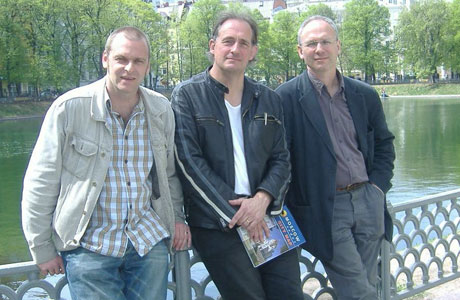
Here is the article by Martin Green on Three Men. Here's the photo they used:
It's an accessible and informative intro to the book and indeed to the whole project. Now we just need to sort out the tour...
Zinovy Zinik's article, translated
Andy has now done a translation of most of ZZ's top article (he says he's missed out the paragraphs he doesn't understand). I've very lightly dusted this with the brush of what I think makes sense. (The original is available for comparison in my comments to the previous entry.)
On Three Men (Not Forgetting the Dog)
All Londoners complain that the underground is expensive and is in a condition of constant repairs because it was built in the middle of the 19th century and resembles a Victorian museum. There is an underground railway in the northern English city of Newcastle. It is also a museo-industrial construction. Three English poets from this industrial capital of the English north - Andy Croft, Bill Herbert and Paul Summers - decided to compare the underground with Moscow.
They re-read the comic travelogue by Jerome K Jerome Three Men in a Boat (Not to Mention the Dog) – which our grandfathers once became engrossed in reading - and have decided to repeat the feats of this unlucky trinity. But they have gone not up the Thames, but to the east, to Moscow and the underground of the Russian capital - they have immortalized their experience of navigating ‘the underground river’ in the form of a book of poems.
In conversation with Bill Herbert, one of the trinity of authors, I asked what seemed to me a little difficult to imagine: how three men could reach Moscow from Newcastle by boat? His reply? The logic in their collection Three Men on the Metro is absolutely poetic, based on coincidences and comic misunderstandings.
In Moscow our heroes felt as ridiculous as Jerome’s characters and as a result a poetic burlesque was born, not about the Moscow River, but about the Moscow Metro, where each station is an occasion for refined parody couplets about the history of Russia and its literature.
Notice that our English travellers quote as an epigraph not Three Men on a Boat, but another book less known to the wide reader, Three Men on the Bummel, about comic adventures of the same characters in Germany. [‘There will be no useful information in this book.’] That book’s narrator is surprised what strange mail boxes Germans seem to have, until he realises that he has mistaken bird-houses for mail boxes.
I especially didn’t envy foreigners who visited the underground several years ago. The names of stations on the underground – as well as streets in the city – were only in Russian, so Englishmen read words like ‘Moscow’ as though Latin letters and the city became ‘Mockba’, and the restaurants turned into the mysterious ‘Pectopan’.
I’ve learned a lot of entertaining facts from the book. For example, the legend that the Circle Line was built where Stalin's cup left circles on the plans given to the leader. Or that the word for the underground is derived from the Greek ‘metera’, meaning womb. So the world of Stalin’s underground for our Englishmen appears as the world of underground Freudian consciousness, in a parodic sense.
Mayakovskaya station, where mosaics represent the Soviet sky rising and then declining, becomes in this book a symbol of the turning world. Here is even Orpheus stuck on the escalator. Not without reason is one of the epigraphs to the book from Dostoevsky’s classic Notes from the Underground, ‘Long live the underground!’
Our trinity appeared in Moscow without a dog; but they, not forgetting about Jerome K Jerome's heroes, found dogs on the way as they closely examined the stations of the underground. A stone's throw away from Mayakovskaya station is the museum of Bulgakov, author of The Master and Margarita and The Heart of a Dog.
In the book there are also two poems devoted to the pig-iron sculptures at Revolution Square station, where the dogs have had their genitals removed so as not to confuse teenagers who to touch everything.
And at Taganskaya station with its cosmonauts, there is a poem about Laika. Not forgetting about Malchik, embodied by its adorers at Mendelevskaya station; both Iskander and Akmadulina, who lived in the neighbourhood, gave money for this monument.
Three Men on the Metro also includes literary parodies on classical and contemporary writers. Here is Byron (whom Pushkin translated) and TS Eliot. There are parodies not only of Akhmatova and Pasternak (who are more less familiar to the English reader), of Yesenin and Mandelstam (who also wrote about the underground), and also on the whole galaxy of authors who have appeared on literary horizon during our epoch – Elena Schvarts, and even Sergey Lukyanenko.
Let's quote (in my improvised translation) only one parody – of our friend, the legendary Moscow poet Lev Rubenstein. He was, as is known, by a trade a librarian, and wrote his poems in phrases on the numbered cards of a library card-index. Here is a typical scene on the Moscow underground – in the spirit of parodying Lev Rubenstein:
[There then follows Zinovy’s translation of ‘This is Us’. Here’s the English version:]
And This is Us
definitely not by Lev Rubenstein
1. This is us.
2. This is us again.
3. This is us outside the Metro.
4. And this is a dog, asleep.
5. Another dog, asleep.
6. And this is a drunk.
7. Sleeping like a dog outside the Metro.
8. Another drunk, also asleep.
9. This is a statue.
10. And this is another statue.
11. This is a dog and a drunk asleep by a statue.
12. This is a dog and a drunk. Asleep by a statue outside the Metro.
13. This is us with a dog and a drunk, asleep outside the Metro.
14. This is a statue of a dog.
15. This is the statue of a drunk.
16. This is us with a drunk by a statue of a dog.
17. This is us with a dog by a statue of a drunk.
18. This is us drunk with a dog by a statue, asleep outside the Metro.
19. This is us.
20. This is us.
21. This is us.
ЭК
On Three Men (Not Forgetting the Dog)
All Londoners complain that the underground is expensive and is in a condition of constant repairs because it was built in the middle of the 19th century and resembles a Victorian museum. There is an underground railway in the northern English city of Newcastle. It is also a museo-industrial construction. Three English poets from this industrial capital of the English north - Andy Croft, Bill Herbert and Paul Summers - decided to compare the underground with Moscow.
They re-read the comic travelogue by Jerome K Jerome Three Men in a Boat (Not to Mention the Dog) – which our grandfathers once became engrossed in reading - and have decided to repeat the feats of this unlucky trinity. But they have gone not up the Thames, but to the east, to Moscow and the underground of the Russian capital - they have immortalized their experience of navigating ‘the underground river’ in the form of a book of poems.
In conversation with Bill Herbert, one of the trinity of authors, I asked what seemed to me a little difficult to imagine: how three men could reach Moscow from Newcastle by boat? His reply? The logic in their collection Three Men on the Metro is absolutely poetic, based on coincidences and comic misunderstandings.
In Moscow our heroes felt as ridiculous as Jerome’s characters and as a result a poetic burlesque was born, not about the Moscow River, but about the Moscow Metro, where each station is an occasion for refined parody couplets about the history of Russia and its literature.
Notice that our English travellers quote as an epigraph not Three Men on a Boat, but another book less known to the wide reader, Three Men on the Bummel, about comic adventures of the same characters in Germany. [‘There will be no useful information in this book.’] That book’s narrator is surprised what strange mail boxes Germans seem to have, until he realises that he has mistaken bird-houses for mail boxes.
I especially didn’t envy foreigners who visited the underground several years ago. The names of stations on the underground – as well as streets in the city – were only in Russian, so Englishmen read words like ‘Moscow’ as though Latin letters and the city became ‘Mockba’, and the restaurants turned into the mysterious ‘Pectopan’.
I’ve learned a lot of entertaining facts from the book. For example, the legend that the Circle Line was built where Stalin's cup left circles on the plans given to the leader. Or that the word for the underground is derived from the Greek ‘metera’, meaning womb. So the world of Stalin’s underground for our Englishmen appears as the world of underground Freudian consciousness, in a parodic sense.
Mayakovskaya station, where mosaics represent the Soviet sky rising and then declining, becomes in this book a symbol of the turning world. Here is even Orpheus stuck on the escalator. Not without reason is one of the epigraphs to the book from Dostoevsky’s classic Notes from the Underground, ‘Long live the underground!’
Our trinity appeared in Moscow without a dog; but they, not forgetting about Jerome K Jerome's heroes, found dogs on the way as they closely examined the stations of the underground. A stone's throw away from Mayakovskaya station is the museum of Bulgakov, author of The Master and Margarita and The Heart of a Dog.
In the book there are also two poems devoted to the pig-iron sculptures at Revolution Square station, where the dogs have had their genitals removed so as not to confuse teenagers who to touch everything.
And at Taganskaya station with its cosmonauts, there is a poem about Laika. Not forgetting about Malchik, embodied by its adorers at Mendelevskaya station; both Iskander and Akmadulina, who lived in the neighbourhood, gave money for this monument.
Three Men on the Metro also includes literary parodies on classical and contemporary writers. Here is Byron (whom Pushkin translated) and TS Eliot. There are parodies not only of Akhmatova and Pasternak (who are more less familiar to the English reader), of Yesenin and Mandelstam (who also wrote about the underground), and also on the whole galaxy of authors who have appeared on literary horizon during our epoch – Elena Schvarts, and even Sergey Lukyanenko.
Let's quote (in my improvised translation) only one parody – of our friend, the legendary Moscow poet Lev Rubenstein. He was, as is known, by a trade a librarian, and wrote his poems in phrases on the numbered cards of a library card-index. Here is a typical scene on the Moscow underground – in the spirit of parodying Lev Rubenstein:
[There then follows Zinovy’s translation of ‘This is Us’. Here’s the English version:]
And This is Us
definitely not by Lev Rubenstein
1. This is us.
2. This is us again.
3. This is us outside the Metro.
4. And this is a dog, asleep.
5. Another dog, asleep.
6. And this is a drunk.
7. Sleeping like a dog outside the Metro.
8. Another drunk, also asleep.
9. This is a statue.
10. And this is another statue.
11. This is a dog and a drunk asleep by a statue.
12. This is a dog and a drunk. Asleep by a statue outside the Metro.
13. This is us with a dog and a drunk, asleep outside the Metro.
14. This is a statue of a dog.
15. This is the statue of a drunk.
16. This is us with a drunk by a statue of a dog.
17. This is us with a dog by a statue of a drunk.
18. This is us drunk with a dog by a statue, asleep outside the Metro.
19. This is us.
20. This is us.
21. This is us.
ЭК
Sunday, 25 October 2009
Three Men on The Strand (well, two)
Listeners to the World Service will have been baffled by a recent item on their arts forum The Strand, in which two poets gibbered at each other about the Moscow Metro before reading some of their so-called verse. Thankfully, presenter Harriet Gilbert brought proceedings to a smart close, but for those intrigued by such matters, the listen again facility is available here.
The BBC's Russian Service has also had to put up recently with one of these poets barking on about some book he'd personally produced on the matter -- if we can find any details of broadcast, we'll be sure to post them.
In other news, a recent meeting in Newcastle's very own Victorian hamam produced the tri bradyagi's new idiot motto, 'Озорство или Cмерть'. This is supposed to mean 'Mischief or Death,' and they have apparently already begun carving it into their forearms with compasses and biro.
However it is already evident that they are backing down on both options. A substitute slogan 'Poems or Hangovers' has already been vetoed on the premiss that they've never had to choose between them before.
Some feedback from around the globe:
'Dear droog, what a smelly book! It's a feast, from the underground bookstores with people who see everything in black and white, to the missing banya with Bill H having lost his map (for Hades perhaps), and Andy C with no immediate access to venik sticks. Now I'll stop jumping from stranitsa to stranitsa and start from page 1. Bolshoe spasibo!’
Kristin Dimitrova, poet (Bulgaria)
‘I can't get over the life in the book. It danced in my hands as I read and wouldn't lie still for hours afterward. You make your journey fun, fun, fun, and far more penetrating, in its real language in a time of "war is peace" and false awards, than Radishchev's road trip to Moscow some 230 years ago. The constant play among you and the moving in-moving out with the people you meet and the scenes you find yourselves in are a whole social portrait in a 100-page travelogue. Brilliant!’
Frank Reeves, poet (US)
Remember, you too can reach this happy station in life by simply buying the book, then (though this is not strictly necessary) reading it.
The BBC's Russian Service has also had to put up recently with one of these poets barking on about some book he'd personally produced on the matter -- if we can find any details of broadcast, we'll be sure to post them.
In other news, a recent meeting in Newcastle's very own Victorian hamam produced the tri bradyagi's new idiot motto, 'Озорство или Cмерть'. This is supposed to mean 'Mischief or Death,' and they have apparently already begun carving it into their forearms with compasses and biro.
However it is already evident that they are backing down on both options. A substitute slogan 'Poems or Hangovers' has already been vetoed on the premiss that they've never had to choose between them before.
Some feedback from around the globe:
'Dear droog, what a smelly book! It's a feast, from the underground bookstores with people who see everything in black and white, to the missing banya with Bill H having lost his map (for Hades perhaps), and Andy C with no immediate access to venik sticks. Now I'll stop jumping from stranitsa to stranitsa and start from page 1. Bolshoe spasibo!’
Kristin Dimitrova, poet (Bulgaria)
‘I can't get over the life in the book. It danced in my hands as I read and wouldn't lie still for hours afterward. You make your journey fun, fun, fun, and far more penetrating, in its real language in a time of "war is peace" and false awards, than Radishchev's road trip to Moscow some 230 years ago. The constant play among you and the moving in-moving out with the people you meet and the scenes you find yourselves in are a whole social portrait in a 100-page travelogue. Brilliant!’
Frank Reeves, poet (US)
Remember, you too can reach this happy station in life by simply buying the book, then (though this is not strictly necessary) reading it.
Sunday, 4 October 2009
First three poems (one each)
Metronomic
‘In the morning I go down in the Metro
There my underground life runs away.’
(Valery Syutkin)
Three hundred feet below the ground,
The Circle Line goes round and round,
De-clunk de-da, de-clunk de-da,
Four syllables to every bar.
‘Dear Passengers,’ the tannoy says,
Uncomradely, though polished phrase
In regular paeonic feet
That fits the Metro rush-hour beat
Of workers paid to feed machines.
The male voice on the tannoy means
We’re ticking clockwise round the stain
Of Stalin’s coffee cup again;
An urgent metre, keeping time,
To which we nod our heads in rhyme
And mark the stress for emphasis,
Rabotniks from Metropolis,
Or clockwork soldiers on parade;
A rhythm made to be obeyed
By veterans with medalled chests,
And Moscow girls with perfect breasts,
And Moscow girls with almond eyes,
And businessmen in suits and ties,
And college kids who text and text
Between one station and the next:
I’m on the train, I’m on the train
I’m on the train, I’m on the train…
ЭК

the beautiful lie
beneath a vaulted arch that’s washed
with lime, the flaking skin of passing
time reveals old joe caught in repose.
when the earth is damp & the mould
blooms ripe, a smoking gun appears, an
unlit pipe conjoining with his roaming,
georgian nose, & not unlike pinocchio’s,
they say it grows with every pretty lie
we hear or tell, with every leap of faith
we make & every unheard prayer, each
sweet mistake, each conjured hell; it
grows like cancer’s cold farewell, the only
spell to counter it the hopeful beat, the
fragile swell of every newborn’s fontanel.
ПС
Notes from the Undermind 1
Time and the Metro love directing
their passengers towards those goals
each thinks is his. No good perfecting
your tunnelled life, good Comrade Mole,
if where your present, past and future
get linked in triple-knotted suture
is also known as, well, the grave,
and no more point in being brave
or sober, son – get stewed, go canine;
sing in the banyas, chase the ZiLs;
denounce your neighbour, neck your pills –
anything but roll round this trainline
dream in, regime out, till you die…
and then you notice: time’s a lie.
The Metro’s icons, too, deceived us:
its paradise looked down, aghast,
as sheaves of shells, not corn, bereaved us
of hope: all harvests turned at last
to that reward of shit-scared squaddies:
barns filled with rapes, mills choked with bodies –
a surplus that wiped values out,
the Motherland washed clean in gouts
of any blood, kulaks’ or killers’,
Chechyen or Georgian, Jew or Pole,
Germans galore, jammed in Death’s hole…
and Russians – always good for filler –
Russians, like kasha, gruel or bread,
Russians will always round out the dead.
Everything we place beneath is lost or
skeletal ideology –
only the Metro keeps its lustre,
by swallowing itself it says
‘Forget words' surface, vote for vowels –
all palaces are in your bowels.’
Ideologues cannot forgive
beneath belief is where we live
with mole and mandrake, salamander –
no apparachnik, no mad priest
can keep all underpants policed;
no desktop-pounding Alexander
can turn a theory into joy:
beneath belief's another Troy.
banya (баня )—bathhouse
BНХ
‘In the morning I go down in the Metro
There my underground life runs away.’
(Valery Syutkin)
Three hundred feet below the ground,
The Circle Line goes round and round,
De-clunk de-da, de-clunk de-da,
Four syllables to every bar.
‘Dear Passengers,’ the tannoy says,
Uncomradely, though polished phrase
In regular paeonic feet
That fits the Metro rush-hour beat
Of workers paid to feed machines.
The male voice on the tannoy means
We’re ticking clockwise round the stain
Of Stalin’s coffee cup again;
An urgent metre, keeping time,
To which we nod our heads in rhyme
And mark the stress for emphasis,
Rabotniks from Metropolis,
Or clockwork soldiers on parade;
A rhythm made to be obeyed
By veterans with medalled chests,
And Moscow girls with perfect breasts,
And Moscow girls with almond eyes,
And businessmen in suits and ties,
And college kids who text and text
Between one station and the next:
I’m on the train, I’m on the train
I’m on the train, I’m on the train…
ЭК

the beautiful lie
beneath a vaulted arch that’s washed
with lime, the flaking skin of passing
time reveals old joe caught in repose.
when the earth is damp & the mould
blooms ripe, a smoking gun appears, an
unlit pipe conjoining with his roaming,
georgian nose, & not unlike pinocchio’s,
they say it grows with every pretty lie
we hear or tell, with every leap of faith
we make & every unheard prayer, each
sweet mistake, each conjured hell; it
grows like cancer’s cold farewell, the only
spell to counter it the hopeful beat, the
fragile swell of every newborn’s fontanel.
ПС
Notes from the Undermind 1
Time and the Metro love directing
their passengers towards those goals
each thinks is his. No good perfecting
your tunnelled life, good Comrade Mole,
if where your present, past and future
get linked in triple-knotted suture
is also known as, well, the grave,
and no more point in being brave
or sober, son – get stewed, go canine;
sing in the banyas, chase the ZiLs;
denounce your neighbour, neck your pills –
anything but roll round this trainline
dream in, regime out, till you die…
and then you notice: time’s a lie.
The Metro’s icons, too, deceived us:
its paradise looked down, aghast,
as sheaves of shells, not corn, bereaved us
of hope: all harvests turned at last
to that reward of shit-scared squaddies:
barns filled with rapes, mills choked with bodies –
a surplus that wiped values out,
the Motherland washed clean in gouts
of any blood, kulaks’ or killers’,
Chechyen or Georgian, Jew or Pole,
Germans galore, jammed in Death’s hole…
and Russians – always good for filler –
Russians, like kasha, gruel or bread,
Russians will always round out the dead.
Everything we place beneath is lost or
skeletal ideology –
only the Metro keeps its lustre,
by swallowing itself it says
‘Forget words' surface, vote for vowels –
all palaces are in your bowels.’
Ideologues cannot forgive
beneath belief is where we live
with mole and mandrake, salamander –
no apparachnik, no mad priest
can keep all underpants policed;
no desktop-pounding Alexander
can turn a theory into joy:
beneath belief's another Troy.
banya (баня )—bathhouse
BНХ
Book Launched

Three men on the Metro was launched on October 1st at Newcastle University as part of the First Thursday events series. All three men and a healthy audience were in attendance as the tri bradyagi (or however we're spelling it this month) rattled through a 45 minute set of underground favourites, as voted for by actual moles.
One in three audience members purchased a copy -- if we can keep to that average in future events the reprint and indeed the Putin-sized yacht cannot be far away. An interesting dynamic appeared in the course of the reading, as Andy and Bill traded humour and acerbity, while Paul provided the lyrical loud/quiet contrast that first brought the Pixies to fame. Now we've just got to get the intros (and the sound FX) into alignment...
For those of you eager to shell out, the book is available here, or for Amazonian pre-order here
Wednesday, 15 July 2009
Banya board meeting balked, sauna substitute a success
By the simple act of not checking first, the tri brodyagi turned up at Newcastle's Victorian City Pool on Ladies' Night, or rather on the evening selected for women to use the Turkish Bath. Says it all, really. Disgruntledly making do with the seventies sauna arrangement next door, the Myetromen discussed final arrangements for the book, including that vital stanza Bill still hadn't written, and readings and other promotional work -- including a First Thursday Reading on October 1st in Newcastle University.
They then transferred to the hot plastic tube of the steam room, a kind of anti-igloo in smooth cream and steam, and considered the possibility of using recordings of the metro and a few nifty slides to announce transitions in the readings, reminded Bill he still had to meet with the cartoonist about the Stations of the Dog strip, and considered a Moscow launch.
Sprawling on the pleather recliners after a refreshing dip in the main pool, they reflected on recent Russian-based reading and news items, including the railway-related issue of renaming Leningrad Station after the tsar, another touch of resurrectionary conservatism; and the unfortunate attempt to close down access to historical resources on the net, another touch of reactionary control-freakery. (You can still access a parallel site by the same author, Vyacheslav Rumyantsev, here, though I can't find an English version.)
They then repaired to a nearby Turkish restaurant to gargle Efes and consume mezes, looking forward to a meeting with their publisher somewhere in York Station to Finalise Everything! Sample stanzas to appear soon...
They then transferred to the hot plastic tube of the steam room, a kind of anti-igloo in smooth cream and steam, and considered the possibility of using recordings of the metro and a few nifty slides to announce transitions in the readings, reminded Bill he still had to meet with the cartoonist about the Stations of the Dog strip, and considered a Moscow launch.
Sprawling on the pleather recliners after a refreshing dip in the main pool, they reflected on recent Russian-based reading and news items, including the railway-related issue of renaming Leningrad Station after the tsar, another touch of resurrectionary conservatism; and the unfortunate attempt to close down access to historical resources on the net, another touch of reactionary control-freakery. (You can still access a parallel site by the same author, Vyacheslav Rumyantsev, here, though I can't find an English version.)
They then repaired to a nearby Turkish restaurant to gargle Efes and consume mezes, looking forward to a meeting with their publisher somewhere in York Station to Finalise Everything! Sample stanzas to appear soon...
Monday, 6 July 2009
Space Dogs
This BBC4 documentary features extraordinary footage of the Russian spaceflights involving dogs.
There are a number of interviews with the scientists who trained them, sent them into space, and mourned the ones that died -- almost half the complement of 48 told to sit whilst being hurtled through the sky.
Among several bizarre quotes, the scientist Aleksandr Seryapin said he was told, 'We're asking you to do something outside your area of expertise... we want you to sew clothes for dogs'; and the rocket scientist Korolyov (who, it was claimed, was deeply attached to his canine cosmonauts), exhorting his fellow workers, 'Remember, Comrades, that a time will come when our trade unions will offer ordinary people holidays in space.'
And the little detail that Stryelka ('Little Arrow', part of the team (with Byelka) that first orbited the Earth and returned safely, had a puppy, Pushinka, that Khrushchev gave to JFK, ostensibly for his children, but obviously so that, every time he watched them play, Kennedy knew that Russia had got there first.
It's repeated a few times this month.
There are a number of interviews with the scientists who trained them, sent them into space, and mourned the ones that died -- almost half the complement of 48 told to sit whilst being hurtled through the sky.
Among several bizarre quotes, the scientist Aleksandr Seryapin said he was told, 'We're asking you to do something outside your area of expertise... we want you to sew clothes for dogs'; and the rocket scientist Korolyov (who, it was claimed, was deeply attached to his canine cosmonauts), exhorting his fellow workers, 'Remember, Comrades, that a time will come when our trade unions will offer ordinary people holidays in space.'
And the little detail that Stryelka ('Little Arrow', part of the team (with Byelka) that first orbited the Earth and returned safely, had a puppy, Pushinka, that Khrushchev gave to JFK, ostensibly for his children, but obviously so that, every time he watched them play, Kennedy knew that Russia had got there first.
It's repeated a few times this month.
Saturday, 9 May 2009
Victory Day
Recent news: Three Men on the Metro secures a publisher. Five Leaves Press is in discussion with us about bringing the book out later this year. Cover image and (finally) a few poems to follow.
Breaking news: Russia celebrates the first public reading from the project by Andy Croft, myself, and Paul Summers, at the Hexham Festival last weekend.
The general announces that, although my first poem went on a bit long, it picked up once we cracked a few jokes. The minister agrees that I should've stopped before the gratuitous Orphic section, but the other two were on cracking form.
Breaking news: Russia celebrates the first public reading from the project by Andy Croft, myself, and Paul Summers, at the Hexham Festival last weekend.
The general announces that, although my first poem went on a bit long, it picked up once we cracked a few jokes. The minister agrees that I should've stopped before the gratuitous Orphic section, but the other two were on cracking form.
Wednesday, 25 March 2009
Myetrodog!
The metrodog website is entirely in Russian, but for those who, like me, either can't read Russian, or are prepared to spend hours transliterating Cyrillic into English they then can't read either, it does have lots of pics of Metro dogs. These invariably look mad, desperate or dazed (visitors to 'Tri brodyagi' sometimes describe themselves as having the same reactions).
'Sobachki,' as I understand it (see first sentence for amount of credence to give to this), not only means 'dog', but also the @ sign, a symbol for which we in miserable English have no word. I imagine it as having something to do with a dog curling up to go to sleep in the warmth of the Metro, but then this could also apply to a number of flexible mammals with tails. Squirrels, for instance. There are uncountable hordes of those in the tunnels.
'Sobachki,' as I understand it (see first sentence for amount of credence to give to this), not only means 'dog', but also the @ sign, a symbol for which we in miserable English have no word. I imagine it as having something to do with a dog curling up to go to sleep in the warmth of the Metro, but then this could also apply to a number of flexible mammals with tails. Squirrels, for instance. There are uncountable hordes of those in the tunnels.
Wednesday, 7 January 2009
Apologies for My Divagation
I'm sure there are no regular visitors to this most irregular of sites, but should anyone be mildly curious about the yawning gaps between entries (and indeed between stated intentions and actual achievement), here's the answer: I lost the notebook.
To be precise, although I still have a hundred photos, fifty recordings, pages of journal entries, numerous sketches, and about five sheets of paper noting conversational topics embarked on during our stay in Moscow, I lost the small moleskine in which I was actually making my notes on the staions as we visited them.
In the meantime, therefore, I've been going on about that on the Lost Notebook site (link to your right), and haven't been able to face updating this blog. But now, as the project moves on, it's time to chat amiably with that particular demon, and come to some arrangement.
The latest news is both Andy and Paul have produced drafts; I'm struggling towards a few sketchy versions of my own, and we're meeting up to discuss the book and its future next week. In a banya. Or rather, in Newcastle's magnificent Turkish Baths.
There's a nice coincidence in this respect in that a parallel project, the 'Balkan Exchange' interaction between NE poets including Andy and myself, and a number of Bulgarian writers, has now acquired a banya-related aspect. Always interesting when such things, like bubbles in the bathtub, spontaneously arise.
Another coincidence that has arisen recently is this photo diary by Linda Nylind, who was evidently in Moscow at around the same time as us, taking snaps of almost the same things: cosmonauts, parades and myetro stations.
Immediate plans for discussing on the deckchairs of the City Pool include: organising the order of the book, discussions with publisher(s), and a reading of material produced so far.
To be precise, although I still have a hundred photos, fifty recordings, pages of journal entries, numerous sketches, and about five sheets of paper noting conversational topics embarked on during our stay in Moscow, I lost the small moleskine in which I was actually making my notes on the staions as we visited them.
In the meantime, therefore, I've been going on about that on the Lost Notebook site (link to your right), and haven't been able to face updating this blog. But now, as the project moves on, it's time to chat amiably with that particular demon, and come to some arrangement.
The latest news is both Andy and Paul have produced drafts; I'm struggling towards a few sketchy versions of my own, and we're meeting up to discuss the book and its future next week. In a banya. Or rather, in Newcastle's magnificent Turkish Baths.
There's a nice coincidence in this respect in that a parallel project, the 'Balkan Exchange' interaction between NE poets including Andy and myself, and a number of Bulgarian writers, has now acquired a banya-related aspect. Always interesting when such things, like bubbles in the bathtub, spontaneously arise.
Another coincidence that has arisen recently is this photo diary by Linda Nylind, who was evidently in Moscow at around the same time as us, taking snaps of almost the same things: cosmonauts, parades and myetro stations.
Immediate plans for discussing on the deckchairs of the City Pool include: organising the order of the book, discussions with publisher(s), and a reading of material produced so far.
Wednesday, 22 October 2008
Arjen Duinker's reading from the underground
Perhaps this is the way we should deliver the poems from this project:
Arjen did a version of this performance on an elevator in the shopping centre in Durres, where the shortness of the ride meant he could read the sequence from Sailors Home, doing a poem on the way up, then another on the way down. He maintained this for the ten part sequence, to the delight, bewilderment and, yes, elevation of many passersby.
Arjen did a version of this performance on an elevator in the shopping centre in Durres, where the shortness of the ride meant he could read the sequence from Sailors Home, doing a poem on the way up, then another on the way down. He maintained this for the ten part sequence, to the delight, bewilderment and, yes, elevation of many passersby.
Subscribe to:
Posts (Atom)


